
Consensus remained elusive on a common BRICS currency as business leaders from the five-bloc nations debated the pivotal issue at a business forum on the periphery of a summit of the five-member bloc being hosted here by South Africa. In their two addresses at the Summit so far, the leaders of Brazil, Russia, India, China and South Africa have made no or scant references to the issue either. "The BRICS Business Forum discussed the international payments system in detail. "Participants also debated the question of whether a BRICS currency is possible or desirable, with strong views expressed both for and against and little consensus reached," Sim Tshabalala, chief executive of Standard Bank Group, told several hundred captains of industry from the partner countries and over 40 other nations across the globe at the Summit.

Six decades and more later, we are now captives of our identities. Every poll is based on elaborate calculations of electability of candidates on the basis of their castes and other narrow definers. That, along with voter promiscuity, is what defines our political culture, which remains stubbornly resistant to any change, asserts Shreekant Sambrani.

'While every year presents new challenges, it also provides opportunities for better growth and performance.'

Cooperatives have demanded the abolishment of income tax on theirs as well as the state cooperative banks' earnings failing which they would resort to agitations across the country.

The formula for success of farm economy is very simple -- farmers should be able to produce more from the same piece of land at reduced cost while minimising risk and be connected to market to get higher realisation for their produce, points out Siraj Chaudhry.

Social stock exchange (SSE) saw its first listing on Wednesday, with SGBS Unnati Foundation becoming the first entity to take this route to avail financing. The foundation - engaged in vocational training of youth - raised Rs 1.8 crore from four investors. These include brokerage firm Zerodha and National Bank for Agriculture and Rural Development (Nabard).

Milk supplies could improve with the monsoon, provided the rains are not excessive.

Given the gap between budgetary allocation and use, a parliamentary standing committee has asked the Ministry of Ayurveda, Yoga and Naturopathy, Unani, Siddha and Homeopathy (Ayush) to take steps to prevent underutilisation of funds under the National Ayush Mission (NAM) scheme. According to the data, the ministry was allocated Rs 1,200 crore for the mission in the Budgetary Estimate (BE) for FY24. The Revised Estimate (RE) for the year fell to Rs 815 crore, of which Rs 589 crore, or 74 per cent, has been spent till January.
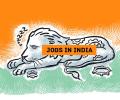
India's unemployment rate fell to a six-year low of 3.2 per cent in the July-June 2022-23 period, down from 4.1 per cent in the same period the previous year, according to the latest annual Periodic Labour Force Survey (PLFS) report. The report, released by the National Statistical Office (NSO) on Monday, showed a decline in unemployment rates in both rural and urban areas during the 2022-23 period to 2.4 per cent and 5.4 per cent, respectively, from 3.2 per cent and 6.3 per cent in the 2021-22 period. The unemployment rate for rural women (1.8 per cent) was lower than that for rural men (2.7 per cent) in 2022-23; in urban areas, the rate was higher for females (7.5 per cent) compared to males (4.7 per cent).

The agreement has ended a wartime standoff that had threatened food security in several countries and cleared the way for exporting tons of Ukrainian grains.
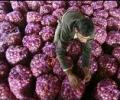
Onion prices crashed to Rs 5-20 a kg in wholesale markets of the national capital on Tuesday on the back of improved supply, but retail prices of the vegetable remain high at Rs 40 per kg.

Dr Shreekant Sambrani pays tribute to M S Swaminathan, renowned agricultural scientist and a lifelong crusader against hunger who passed away in Chennai recently.


Loan waivers will never be enough. Reforming the agricultural marketing system is essential to addressing the concerns of farmers in a sustainable manner, says Nitin Desai.

President Ram Nath Kovind addressed the nation on the eve of India's 75th Independence Day. Here's the text of what he said:
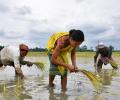
In the coming months, globally as well as in India, rice might remain a hot potato.

'The policy is to consolidate farming into the hands of a few and to take away the food security of the country.' 'Once food is in the hands of 15 chosen corporate houses, you will get food, but at a price that they determine.'
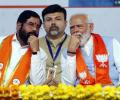
'There are legions of unemployed degree holders across rural and semi-urban belts in Maharashtra. Now, they aren't finding brides.' 'This issue has now snowballed into a social crisis. In 2014 and 2019, they had voted for the BJP.'

'The BJP alliance needs to handle the Maratha quota issue skilfully and address its root cause, which is agrarian distress. Then there is stalled industrialisation. If these issues are addressed, caste fault lines would wither away. But, this is next to impossible in a short span of three-four months.'
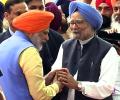
Whether it was the MGNREGS or the NFSA or the Aadhaar-based DBT scheme for cash transfer, the Modi government has built on the basic architecture created by the Singh government. Policy makers in the Modi government, instead of discarding them as products of the previous political regime, worked on them, expanded their scope and reach, and used new tools to improve their performance, explains A K Bhattacharya.

Even as the bilateral relationship between the two neighbouring countries remains hostile, there is growing coordination between India and Pakistan on one multilateral forum - the World Trade Organization (WTO). Both countries have made two joint submissions at the WTO as co-sponsors in the past two months. In June, Pakistan joined India, Cuba, and 44 African countries, seeking sufficient flexibility in intellectual property rights for developing countries to fight the Covid-19 pandemic.

'We want to make sustainability affordable.' 'We tell everyone, don't just recycle, Craste it!'

Having created businesses ranging from world's largest single-location oil refining complex to nation's largest mobile network operators in just few years, billionaire Mukesh Ambani says his group Reliance Industries Ltd will never be complacent and will grow to be among the top 10 business conglomerates of the world. Addressing employees on Reliance Family Day - the birthday of the group's founder Dhirubhai Ambani, he said Reliance is now aiming to consolidate a place among global leaders in digital data platforms and AI adoption. "Today, the domestic and global environments for business are changing very fast.

Elections are not won or lost by expounding on such macro-economic matters. For the aam admi, what matters in manifestos are promises that will improve their quality of life, notes Vinayak Chatterjee.

'When you do some job for a few hours, you are hardly earning enough to survive.'

As more companies ask their employees to return to office after the pandemic, the share of women employed in regular salaried jobs in urban India decreased from 54 per cent in the first quarter to 52.8 per cent in the second quarter of the current financial year, according to the quarterly Periodic Labour Force Survey (PLFS) data. The slump in the share is the lowest in wage employment in any quarter in the last six years when the National Statistical Office started releasing the quarterly PLFS surveys in Q3 of FY19. The share of women in wage work was highest in Q1 of FY21 at 61.2 per cent.
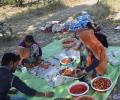
'To bring about a paradigm shift in farmers's income, we need to change our approach to agriculture, and transit from the narrow prism of cultivation to a full-fledged enterprise, by building all associated supply chain linkages.' 'This alone will make the farmer an entrepreneur in his own right.'
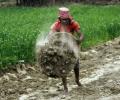
Kiran Vissa, co-convenor of National Alliance for Sustainable Agriculture, said that amendments to the EC Act have nothing to do with farmers' welfare but instead meant to please big players and agriculture companies. This is because small and marginal farmers don't have the storage capacity to attract provisions of the EC Act.

Could the MPCE survey results be used as a basis of reconstructing the Consumer Price Index with new weights, asks Madan Sabnavis.
The government was going in the "wrong direction" and it was "highly condemnable" that it did not discuss the proposed changes with trade unions and other stakeholders, says BMS, trade union arm of the RSS.

Farmers from Punjab clashed with Haryana police at two border points between the states on Tuesday, facing tear gas and water cannons as they tried to break past barricades blocking their protest march to the national capital. The police lobbed tear gas shells -- some of them dropped from a drone -- and tried to disperse groups of stone-pelting protesters in the face-off that last several hours at Shambhu border near Ambala in Haryana.

The government has identified nine key focus areas in the AI national programme, including agriculture, education, Indian languages, smart cities, cybersecurity, transportation, and finance.

Union Agriculture and Farmer Welfare Minister Munda, Commerce and Industry Minister Piyush Goyal and Minister of State for Home Affairs Nityanand Rai represented the Centre at the meeting over the farmer unions' various demands, including a law guaranteeing a minimum support price (MSP) for crops. Punjab Chief Minister Bhagwant Mann also joined the meeting at the Mahatma Gandhi State Institute of Public Administration in Sector 26. The meeting started at around 8:45 pm on Thursday and lasted for around five hours.

National Agricultural Cooperative Marketing Federation, the central government's procurement agency for non-cereal crops, is in talks with leading retail companies to serve as a back-end supply chain in agri-commodities.

Thousands of farmers, mainly from Punjab and Haryana, are protesting at various borders of the national capital for more than a month against the laws and are demanding that these be repealed.

A large car caravan of protesters from various parts of California blocked the traffic on the Bay Bridge on Saturday as they moved towards the Indian Consulate in San Francisco, while several hundreds gathered in downtown Indianapolis.
Critics argue that much more could have been done and that the government was slow to react to many events.

Concerned over skyrocketing prices of onion due to supply scare in the market, government on Monday decided to import onions from China and Pakistan to tide over the crisis.

Nearly a third of an average Indian citizen's consumption budget is spent on food.

Assuming we still have a Modi-led majority government after May 2024, there is no guarantee that reforms will move at anything more than a snail's pace, though we must be thankful even for that, notes R Jagannathan.
